A Trophy Kill That Sparked the Hunt for Bin Laden
Twenty-five years ago today, two men posing as journalists detonated a bomb hidden in their camera equipment, killing Ahmad Shah Massoud, the Lion of Panjshir. Little did I know at the time that his death on the 9th of September 2001, would rearrange the entire course of my life. It would take years – and a great deal of loss – before I would fully understand the knock-on effect of that single, calculated act.
Massoud's assassination was not an isolated tragedy. It was the start of a terrorist campaign that brought down New York’s twin towers and took thousands of lives. Two days after Massoud’s assassination, the world finally understood what he and other high-profile Afghans had been warning for years: that al-Qaeda and their Taliban hosts posed a threat far beyond Afghanistan's borders.
Massoud’s murder was timed to clear the ground before 9/11. With the Northern Alliance leader gone, the hope must have been to weaken resistance to balance the coming storm. But if this was the plan, it was a serious miscalculation by Bin Laden and within weeks of 9/11, Operation Enduring Freedom was underway backed by a reinvigorated army of anti-Taliban fighters – and I found myself, along with the rest of the world's press, converging on Northern Alliance territory to watch how the war for Afghanistan's future would play out.
From the very start, it was an incredible experience that took me from Tajikistan, lying north of Afghanistan, into the Northern Alliance stronghold of Khwaja Bahauddin and the headquarters of the resistance where Massoud’s murder had taken place a month or so before. From there I travelled by jeep into the heart of the Hindu Kush, taking the breath-taking – and torturous – route along the Anjuman Pass that eventually spilled us out onto the fertile plains of the Panjshir Valley and its white rock road shadowed by a turquoise river.
By this stage of our journey, every vehicle we passed carried Massoud's photograph taped to the windscreen and, once we arrived to set up home in Jabal us Siraj on the frontline, our jeep carried his photo too.
Amazingly, for all the death that had brought us there, this was a time of enormous hope and I spent the days waiting for the fall of Kabul with the generals and leaders who had stood shoulder-to-shoulder with Massoud, including the late Sayed Hussein Anwari and the former vice-President Haji Abdul Qadir, who was assassinated ten months later. At that time, I had no way of knowing that Qadir would go on to shape my life more profoundly than Massoud's death had done, but like the greater picture that accompanied the Lion of Panjshir’s murder, it was the start of a story I would have no control over and one that would change my life irrevocably.
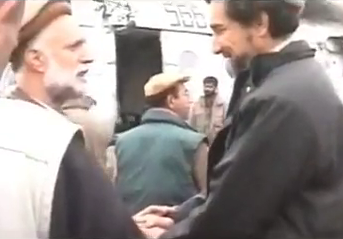
Haji Abdul Qadir and Ahmad Shah Massoud